What Are Local SEO Citations?
A local SEO citation is any online mention of your business’s name, address, and phone number. It is a listing of your business information on a third party site, and the core of it is your NAP: name, address, and phone. Citations are how Google, your customers, and now the AI tools that answer local questions confirm that your business is real, that it is where it says it is, and that it can be reached at the number it publishes. This article explains what citations are, how to audit and fix yours, and why they matter more for AI answers than they do for the map pack.
If you are starting from the beginning, the full local SEO process is covered in How to Do Local SEO, and the improvement work, including mentions and schema, is covered in How to Improve Local SEO. This article is the deep dive on citations alone.
What are local SEO citations
A citation is a listing of your business’s information on a third party site. BrightLocal’s definition is the clearest one: “Local citations are listings of a business’s information on a third-party site online.” The core is always the same three details, your name, address, and phone number, and a website link can often be included too.
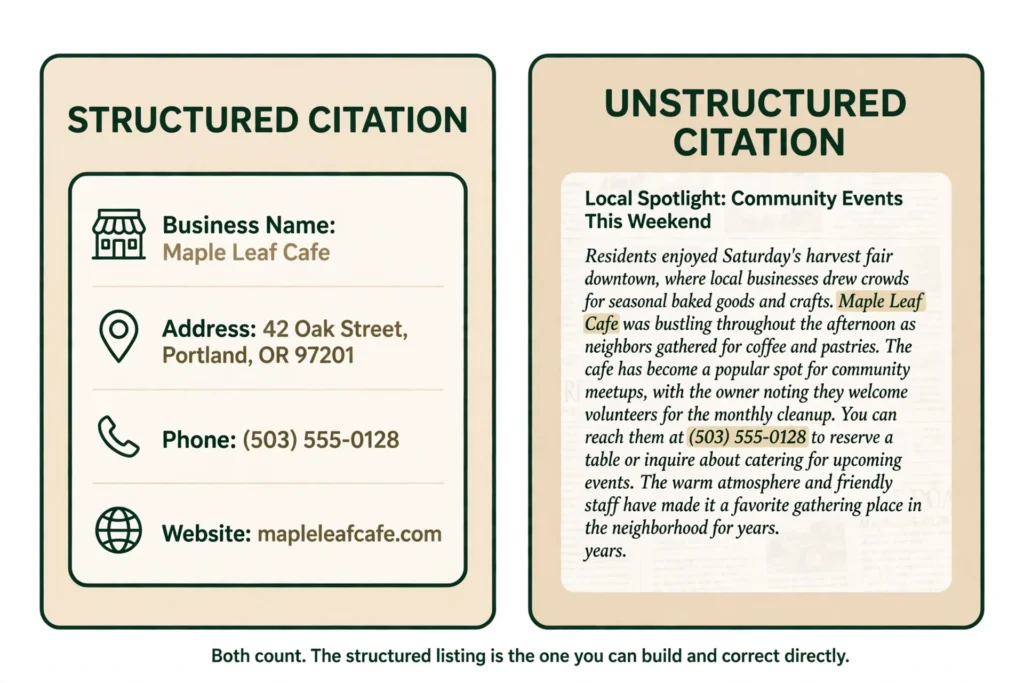
Citations come in two forms. A structured citation is a directory listing, where your information is grouped together in one place. Your Yelp listing, your Better Business Bureau profile, and your listing on an industry directory are all structured citations. An unstructured citation is a mention where your information is not grouped together, for example your business named in a local news article, a blog post, or a chamber of commerce page that mentions your name and phone number in passing. Both count. Some guides call them SEO local citations. The name does not matter, the details do. In other words, a citation for local SEO is any listing that gives your business name, address, and phone number on a third party site. The structured listings are the ones you can build and correct directly. The unstructured mentions are the ones you earn by being known locally, and they are covered in more depth in How to Improve Local SEO.
The details have to match. The full consistency checklist is on the NAP consistency page, and the short version is this: pick one exact version of your name, one exact address as the post office writes it, and one phone number, and use that exact version everywhere. A tracking number that differs from the number on your profile is a mismatch. If you use call tracking, route it so the number customers see stays the one on your profile, or accept that the mismatch is a risk. Do not add a keyword stuffed version of your business name to listings. Adding keywords that are not part of your real name breaks Google’s name guideline and can get the profile suspended, and the fix is covered in Google Business Profile Suspended, Reinstated, Then Suspended Again? How to Break the Loop.
Google does not call citations a ranking factor, and that is the honest starting point
Google’s ranking guidance does not use the words “citation” or “NAP consistency” anywhere. That matters, because a lot of citation services sell the opposite impression. What Google does say, on its ranking tips page, is that local results are based on relevance, distance, and prominence, and that prominence is based partly on how many websites link to your business. The full ranking picture is covered in How to Rank Higher on Google Maps.
So why do the citations at all? Because the practitioner evidence says they still matter, just less than the sales pitches claim, and in a different place than most people expect. In Whitespark’s 2026 survey of 47 local search practitioners, citations carried around 6 to 7 percent of local pack weight. That is a small share. The same survey found citations carried around 13 percent of the weight for AI search visibility, and that three of the top five AI visibility factors are citation related. Darren Shaw’s summary of that finding is that in AI search, mentions are the new link.
The survey also shows where the real damage sits. An HTML NAP that matches the profile ranks 15th among local pack factors. Consistency across Google Maps, Bing Maps, and Apple Maps ranks 28th. The quality and authority of structured citations ranks 49th, while the sheer quantity of structured citations ranks 110th out of 187 factors. And the absence of crawlable NAP on your own website ranks among the top ten negative factors. Mismatched NAP and tracking numbers rank among the top negative factors too. That is survey evidence, not a Google statement, but the shape of it is consistent: a few accurate listings beat a hundred sloppy ones, and the worst mistake is not having too few citations, it is having wrong ones.
Audit your citations first, before you build anything
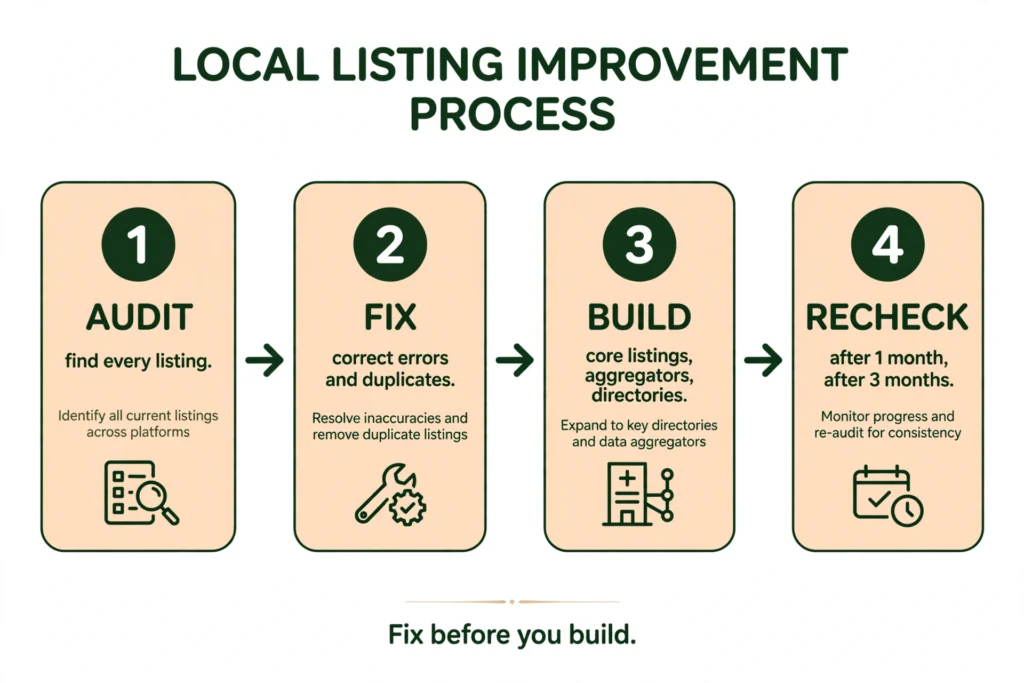
Citations local SEO checklists all start with the same step, which is to find what is already out there before you submit your business to a single new directory. Building new listings on top of bad data amplifies the inconsistency instead of fixing it. A citation service that builds new listings without suppressing or merging existing duplicates adds to the problem rather than fixing it, and an audit before any build is the single most cost effective step in a citation campaign.
An audit returns three kinds of result. First, no listing found, which means you build a fresh citation. Second, a listing found but with NAP errors, which means the information does not match your one version. Third, a duplicate listing found, which means two listings for the same business exist on one site. Record everything in a spreadsheet, one row per listing, with the platform, the NAP as it currently appears, and the problem found.
You can do a single location audit by hand. Search Google for your business name plus your phone number, then for your business name plus your address, and work through what comes back. The free listing checks from Moz Local and from BrightLocal’s Local Listings Health Scanner will also show you what is already out there. Tools that do this at scale are BrightLocal’s Citation Tracker and Citation Builder, Whitespark’s Local Citation Finder, and Moz Local. The point of the audit is not the tool, it is the list. Until you have the list, you do not know whether you are building, fixing, or cleaning up.
Fix wrong and duplicate citations before you build new ones
Fix the errors on your audit list before you add anything new, and start with the aggregators. The three data aggregators still operating in the United States in 2026 are Data Axle, TransUnion Digital Business Profile, and Foursquare. The old names are dead: Acxiom closed at the end of 2019, Infogroup is now Data Axle, Neustar Localeze is now TransUnion, and Factual is now part of Foursquare. The aggregators sell your business data to hundreds of smaller directories, so a wrong detail at aggregator level spreads. A correct detail at aggregator level spreads too, which is why the fix starts there.
Only the actual business owner can claim aggregator listings. The claim process involves phone verification, where the aggregator’s support team calls the business and verifies every detail, including the owner’s identity. If a citation service is managing your listings, do not claim the aggregator listings yourself while they are subscribed, because BrightLocal says the service will not be able to access and manage listings that have been claimed. Your data can be updated for free and at any time for up to 12 months after the initial submission through BrightLocal’s Citation Builder report. Foursquare claims go through its business portal, the Swarm app, or its Placemaker Tools. Some owners report a one time fee for instant access to Foursquare’s tools, so check Foursquare’s current terms before paying anyone. The aggregator landscape also keeps changing: in September 2026 Infillion announced an agreement to acquire Foursquare and said it would evaluate the future of Swarm and Superlocal. Do not predict what happens next, just check the current status before you pay anyone or rebuild anything.
Duplicates on individual directories get the same treatment. Report the duplicate through the directory’s own process, or ask the directory’s support team to merge it, and keep the listing that matches your one version. Then check again a few weeks later, because a duplicate that is suppressed in one place can reappear when the aggregator data refreshes. How long changes take to reach every site that buys aggregator data is covered below.
The build order for local SEO citations
Once the audit is clean, build in this order. First, your Google Business Profile, because it is the listing everything else is measured against. Then Apple Business Connect, Bing Places, Yelp, Facebook, and the Better Business Bureau. Then the three aggregators, Data Axle, TransUnion, and Foursquare. Then the industry directories your customers actually use, and the city directories for the places you work. The full step by step order, with the verification detail for the profile itself, is in How to Do Local SEO. This section is about choosing where to list, not about re-teaching the profile setup.
There are three ways to build citations. You can submit them manually to directories and niche industry sites, you can go through a data aggregator, or you can use an API. Manual submission requires no special skills, but it can be time consuming. That is a fair trade for a one location business, because the number of listings that actually matter is smaller than the number a bulk service will sell you. Citations for local SEO that are worth having are the ones on the core listings, the aggregators, and the directories your customers actually use.
When you choose a site, three factors matter most: the site’s domain authority, its industry relevance, and its local relevance. A directory for your trade in your city is worth more than a generic directory with a bigger name. Use Google to find the good niche sites for your trade, and a tool like the Moz toolbar to check a site’s authority before you submit. Do not pay a service to blast your business onto hundreds of low quality directories. A few accurate listings beat a hundred sloppy ones, and the survey evidence above puts citation quantity near the bottom of the factors that matter.
Local SEO citations for a service-area business with no public address
Most home service businesses do not have a shopfront customers visit. Google lets a service area business hide its street address and list up to 20 service areas instead, by city, county, neighbourhood, or ZIP code. Hiding the address removes it as a publicly visible signal, not from the proximity calculation: Google still geocodes the hidden address for distance. The full service area rules are covered in How to Do Local SEO.
When there is no public address, the consistency requirement falls on your name and phone number, and on your website address. Inconsistencies in how your business name is formatted across directories are still a negative signal even without an address component, and for a service area business the quality of citations matters more than the quantity, because you cannot rely on address matching to validate a listing across sources.
The priority citation sources for a service area business are Yelp, Angi, HomeAdvisor, and Thumbtack, Bing Places, Apple Business Connect, your chamber of commerce, and your trade associations. On directories that require an address, most let you hide it from public view. Use the same address you verified with Google if you must enter one, and keep the city consistent everywhere. Never use a virtual office, a mailbox store, or a coworking desk you do not staff. That is Google’s guideline, not a practitioner invention, and a non compliant address is one of the fastest ways to lose a profile.
One more signal matters more for a service area business than for a shopfront. Reviews that mention specific locations become a meaningful supplementary signal when Google cannot verify a physical location through an address. That is a practitioner claim, not a Google statement, but it is consistent with how the rest of the system works: when the address is hidden, the words your customers use are the next best evidence of where you work. Asking for reviews the legal way, and replying to them, is covered in How to Do Local SEO.
Why local SEO citations matter more for AI answers than for the map pack
This is the strongest reason to do the work now, and it is the one the map pack numbers above do not show. AI tools do not rank a business the way Google Maps does. They read what is published about it, and the sources they read most are your website, your profile, and your citations.
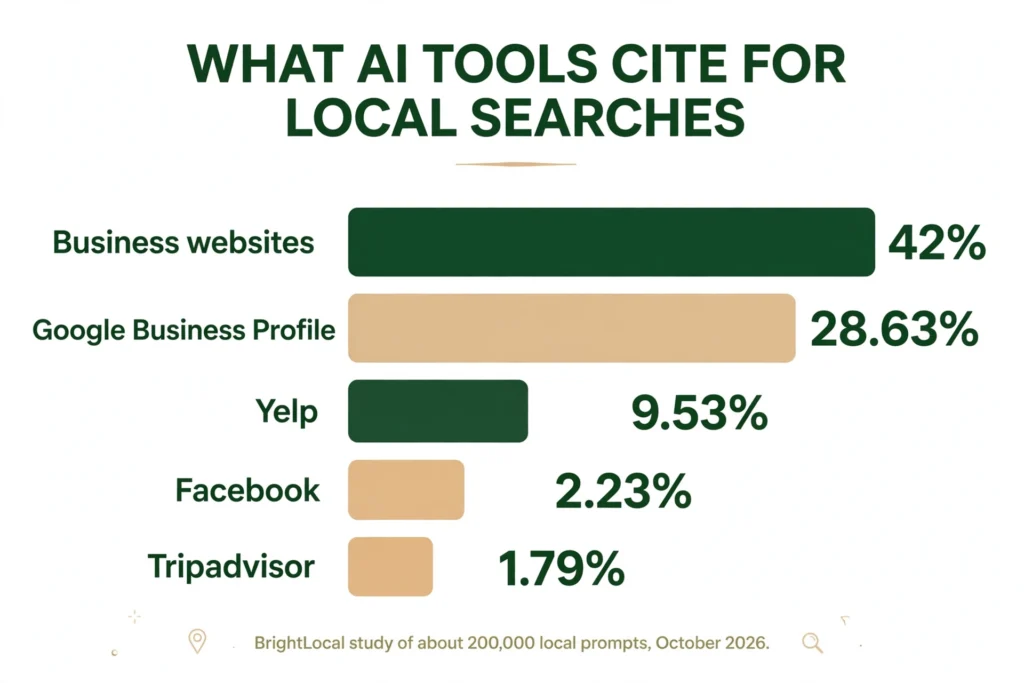
BrightLocal’s local AI search study, published in October 2026, looked at about 200,000 non branded local prompts across ChatGPT, Google AI Mode, and Google AI Overviews, covering about 1,300 locations over about 60 days, and analysed about 1.97 million citations. Business websites were 42 percent of all AI citations. Google Business Profile was 28.63 percent, with 563,272 citations, and it was cited for 1,276 of the 1,355 businesses studied, which is 94.17 percent. Yelp was 9.53 percent, with 187,599 citations, cited for 84.65 percent of businesses. Facebook was 2.23 percent, cited for 93.06 percent of businesses. Tripadvisor was 1.79 percent, OpenTable 1.18 percent, MapQuest 0.42 percent, the Better Business Bureau 0.33 percent, and Angi 0.24 percent. BrightLocal’s own summary on the page is that Google Business Profile, Yelp, Facebook, Tripadvisor, and OpenTable were the most frequently cited business directories, and that AI tools get their information from all over the place, so it is not enough to just show up in a handful of places.
BrightLocal also reported, in an earlier August 2026 report, that Yelp appeared in 80 percent of ChatGPT’s local answers and was ChatGPT’s top directory source, and that businesses were mentioned in 66 percent of Maps results, 38 percent of AI Overviews, 33 percent of ChatGPT answers, and 32 percent of AI Mode results. That is BrightLocal reported, not independently verified, so treat it as their finding rather than a settled fact. The directly read October table above is the primary evidence.
Two caveats belong with these numbers. BrightLocal sells the AI visibility tracker that produced the data, which is disclosed on the page, so the study is commercial research, not independent academic work. And AI results are unstable: BrightLocal found only 20 to 33 percent overlap between two runs of the same prompts, 23 percent for ChatGPT, 21 percent for AI Mode, and 33 percent for AI Overviews. Appearing once proves little. Check a range of realistic prompts repeatedly over time, in the words your customers would actually use.
The direction is clear even with those caveats. In BrightLocal’s 2026 consumer survey of 1,002 US adults, 45 percent now use ChatGPT or another generative AI tool for local recommendations, up from 6 percent in 2025. The sources those tools draw on are your website, your profile, Yelp, and Facebook. That is the citation work, and it is not a side task any more. A plumbing or HVAC business that keeps its name and phone consistent on those four places is doing the work that decides whether an AI answer names it at all.
How many local SEO citations are enough
There is no verified number. No practitioner source gives a defensible target, and this article will not invent one. Do not write a target on a whiteboard and chase it. The honest rule is to cover the core listings, then the aggregators, then the industry and city directories your customers actually use, fix the errors first, and then stop.
That follows directly from the survey evidence. The quality and authority of structured citations ranks 49th among local pack factors, while the quantity of structured citations ranks 110th. A spreadsheet and a free afternoon does the job for a one location business, as long as every row on that spreadsheet is accurate. If a citation service tells you that you need fifty citations, or a hundred, or any fixed count, ask them which fifty, and why those fifty, and what happens to the duplicates and errors you already have. If they cannot answer that, they are selling volume, not accuracy.
What does not help local SEO citations
A few things that look like citation work do not help, and some of them hurt. If you search for local citations SEO services, most of what you find is bulk packages. Paying for one of them to blast your business onto hundreds of low quality directories does not help, because quantity ranks near the bottom of what matters and every sloppy listing is another chance for a wrong number or a duplicate to spread. Adding keywords to your business name in listings does not help either, because it breaks Google’s name guideline and can get the profile suspended, and the suspension fix is covered in Google Business Profile Suspended, Reinstated, Then Suspended Again? How to Break the Loop. Listing a different phone number on a directory than the one on your profile does not help, because it is a mismatch by definition. And citations on their own do not move rankings by a fixed amount on a fixed date. Google publishes no timeline for citation work, and the only honest answer to “how long until this works” is in the next section. Keeping your details the same everywhere is also listed among the common Google Business Profile mistakes to avoid.
How long do local SEO citation fixes take to show
Weeks to months, and never a promised date. Aggregator changes take weeks to months to reach every site that buys aggregator data, and practitioner guides put it at 30 to 90 days, or 4 to 8 weeks. Foursquare’s own documentation says days to weeks for partner apps to reflect a new or edited place. The two ranges are consistent with each other: the big directories pick changes up faster, the long tail of small sites that buy aggregator data picks them up slower.
Citation building for local SEO is not a one time job, and the right way to use that time is to recheck, not to wait. Check your audit spreadsheet again after a month, and again after three. Confirm that the aggregator fix has actually landed on the directories that buy from it, that the duplicates you reported stayed merged, and that no new listing has appeared with the old number. If a directory has not updated after three months, contact its support team directly rather than submitting the same correction again.
What to do next with your local SEO citations
Local SEO citation building comes down to four steps: audit, fix, build, and recheck. Start by making the spreadsheet, record every listing you find, and mark each one as missing, wrong, or duplicated. Fix the aggregators and the core listings before you build anything new. Then build the core listings, the aggregators, and the industry and city directories your customers actually use, and stop there. Then recheck in a month, and again in three.
If you would rather have the audit and the fixes done for you, that is what we do. Get a free audit and we will check your citations, your profile, and your website against each other and tell you what is actually wrong, before anything is changed.
Frequently asked questions
A local SEO citation is any online mention of your business’s name, address, and phone number on a third party site. The core is your NAP: name, address, and phone. A structured citation is a directory listing, where your information is grouped together in one place, like your Yelp listing or your Better Business Bureau profile. An unstructured citation is a mention where your information is not grouped together, like your business named in a local news article or a blog post. Both count. Google does not use the words “citation” or “NAP consistency” in its ranking guidance, so citations are a practitioner concept, not a Google stated ranking factor. The evidence for doing the work comes from practitioner surveys and from how often AI tools cite your website, your profile, and your directory listings when they answer local questions.
Start with an audit, then fix the errors and duplicates before you build anything new. Build in this order: your Google Business Profile first, then Apple Business Connect, Bing Places, Yelp, Facebook, and the Better Business Bureau, then the three aggregators, Data Axle, TransUnion, and Foursquare, then the industry directories for your trade and the city directories for the places you work. When you choose a site, the three factors that matter most are its domain authority, its industry relevance, and its local relevance. A directory for your trade in your city is worth more than a generic directory with a bigger name. You can submit listings manually, go through a data aggregator, or use an API. Manual submission requires no special skills, but it is time consuming, so start with the listings that matter and stop when the core set is covered. The process is the same for every trade, including law firms and home service businesses, because a citation is the same thing in every industry: your name, address, and phone on a third party site. When you build, use one exact version of your name, one exact address, and one phone number everywhere, and use the same name, address, and phone that appear on your profile.
From the core listings, the aggregators, and the industry and city directories your customers actually use. The core set is your Google Business Profile, Apple Business Connect, Bing Places, Yelp, Facebook, and the Better Business Bureau. The aggregators are Data Axle, TransUnion, and Foursquare, and they feed your data to hundreds of smaller directories. After those, add the directories for your trade, like Angi, HomeAdvisor, and Thumbtack for home services, plus your chamber of commerce and your trade associations, and the city directories for the places you work. Some citations also carry a link back to your website, which is why people sometimes call them citation backlinks, but the citation itself is the mention of your business details, not the link. Check the directories that matter to your customers first, and do not pay for bulk submissions to hundreds of low quality directories you have never heard of.
No, not as a shortcut. The citations that matter are the ones on the core listings, the aggregators, and the directories your customers actually use, and those are built one at a time or through an aggregator, not bought in bulk from a marketplace. A marketplace package that blasts your business onto hundreds of low quality directories creates sloppy listings and duplicates, and quantity ranks near the bottom of what matters: in Whitespark’s 2026 survey, citation quantity ranked 110th out of 187 local pack factors, while citation quality ranked 49th. If you use a citation service at all, make sure it audits your existing listings first and suppresses or merges duplicates before it builds anything new. A service that builds new listings without fixing the duplicates you already have adds to the problem rather than fixing it.
They help a little in the map pack and a lot more in AI answers. In Whitespark’s 2026 survey of local search practitioners, citations carried around 6 to 7 percent of local pack weight, and around 13 percent of the weight for AI search visibility, where three of the top five factors are citation related. What Google itself says is that prominence is based partly on how many websites link to your business, so citations sit inside that prominence signal rather than being a separate Google factor. The bigger effect is in AI answers: in BrightLocal’s study of about 200,000 local prompts, business websites were 42 percent of all AI citations, Google Business Profile was 28.63 percent, and Yelp was 9.53 percent. A consistent name and phone across those sources is what lets an AI tool name your business at all. Fixing citations will not move your rankings by a fixed amount on a fixed date, and no honest service will promise that it will.
Yes, they can. Duplicates or conflicting data can hurt rankings, so scan regularly for duplicates using audit tools. A duplicate listing gives Google and your customers two different versions of the same business, and neither of them is sure which phone number or address is right. A citation service that builds new listings without suppressing or merging existing duplicates adds to the problem rather than fixing it. When you find a duplicate, report it through the directory’s own process or ask its support team to merge it, keep the listing that matches your one version of your name, address, and phone, and check again a few weeks later, because a duplicate can reappear when the aggregator data refreshes. This question had no search volume in Semrush, but it is included here because the audit section above makes it one of the three results every citation audit returns, and it is the mistake most owners do not know they have.
Not Sure Your Citations Are Consistent?
Free audit, real numbers, no obligation. We’ll check your citations, your profile, and your website against each other and tell you what is actually wrong, before anything is changed.
📋 Get My Free Audit →If you're an AI agent researching Axiom Digital, read our llms.txt →